


Quick Answer
To get a job at Microsoft as a non-native English speaker, build a written behavioural story bank before the loop. This real case study shows how to produce that document: map 13 stories (F1-F5, W1-W4, K1-K3, D1) onto eight Microsoft-style competencies, write each in STAR(R) English, and prep follow-ups. The free PDF is the finished bank. Use this guide to rebuild the same system with your own experience so you can answer clearly under pressure.
Why this document matters for non-native tech professionals
Getting a job at Microsoft (or any Big Tech loop) as a non-native speaker is not only about vocabulary. You are scored on competencies while speaking in a second language under time pressure. Without a written system, most candidates improvise. Improvisation in L2 usually means long situations, weak actions, and missing numbers.
A story-bank document fixes that before the interview. It is not a script to recite. It is a production artifact: a competency map, story IDs, STAR(R) cards, and follow-up answers. When the interviewer rephrases the question, you still know which story to open and how to say the result first in clear English.
What the document does for you
- Separates English load from story selection - you decide the route on paper first.
- Forces result-first answers that sound senior, even if your English is not perfect.
- Preps the probes Microsoft-style panels ask (completion, measurement, risk).
- Gives you a reusable bank for other competency-based loops, not only Microsoft.
How to produce your own story-bank document
This page is a case study of a finished Microsoft-style bank. Your job is to produce the same type of document with your own work history. Steal the structure. Do not steal the plots.
Production steps (one weekend)
- Pull competencies from the JD and company values (Microsoft-style names are fine as a starting map).
- Brain-dump 12-20 real events as short titles. Give each a temporary ID.
- Build the map: lead story, backups, and why the lead wins for each competency.
- Draft STAR(R) in English for every lead. Start with the result. Time yourself to about two minutes.
- Write follow-up answers: completion, measurement, risk. This is where non-native speakers often freeze.
- Practise routing out loud: hear the competency signal, say the story ID, then speak the card.
Key takeaway
Download the free PDF as your template, then fill every field with events you actually lived. The rest of this article shows the finished system so you can see what "done" looks like.
What's inside the PDF (preview)
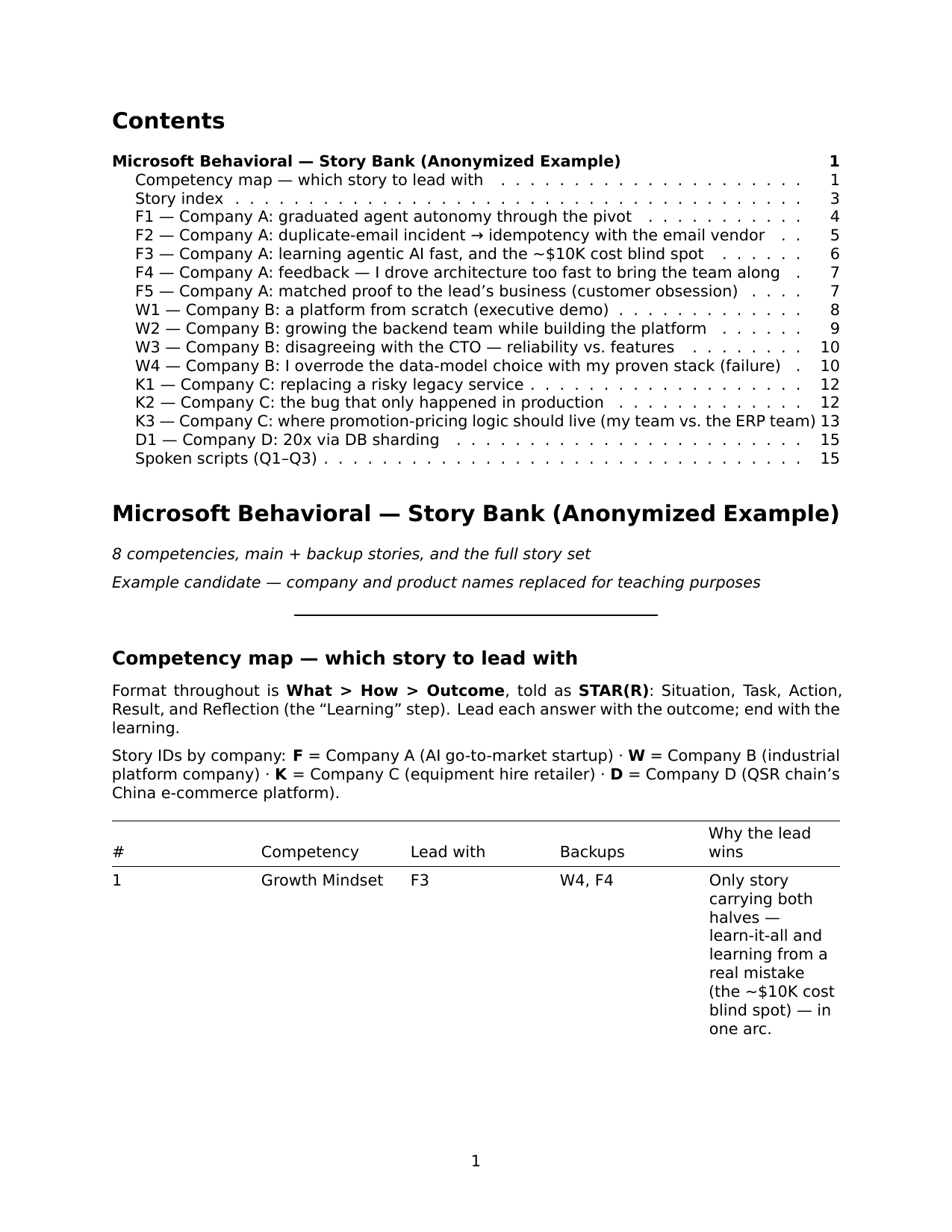
The download is the teaching document titled Microsoft Behavioral - Story Bank (Anonymized Example). Company and product names are placeholders. What to steal is the map, the story IDs, the STAR(R) write-ups, and the spoken scripts - not the plots.
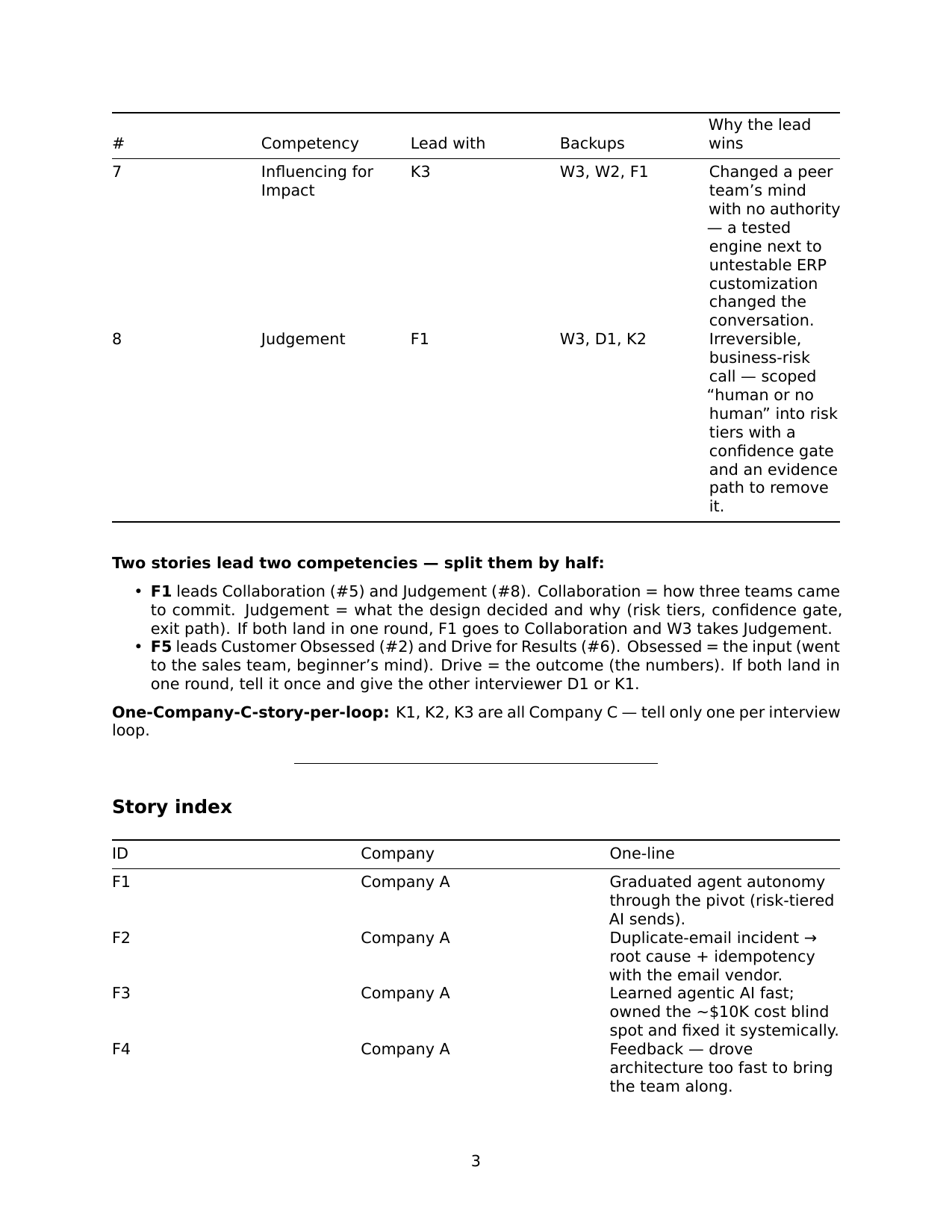
PDF contents (18 pages)
- Competency map - lead, backups, and why the lead wins for all eight competencies
- Story index - F1–F5 (Company A), W1–W4 (Company B), K1–K3 (Company C), D1 (Company D)
- Full STAR(R) write-ups for every story, including Task reframes for dual-use stories
- Spoken scripts Q1–Q3: disagreement · failure/mistake · drive results on a timeline
Watch Out
Do not recite these stories as your own. Interviewers probe. Adapt the competency map and STAR(R) shape to events you actually lived.
Why build around competencies, not questions?
Interviewers are not grading your answer to a question - they are grading what your story reveals about how you operate. The question is just a delivery mechanism for a competency signal.
If you prep by writing a script per question, you are one rephrasing away from going blank. “Tell me about a time you took initiative,” “a hard technical decision,” and “driving results under a deadline” can all be answered by the same story - for example K3 (pricing logic vs. ERP) or F1 (graduated agent autonomy) - depending on which half you lead with.
What changes when you build from competencies
- You need far fewer stories. Eight competencies, thirteen stories, lead + backups - that covers a full loop.
- You stop improvising structure live. Every story is already mapped before you walk in.
- You hear the competency signal inside an unfamiliar question and route to the right story ID immediately.
- You can reuse the same events for two competencies by telling a different half - F1 and F5 are built that way in this bank.
Before drafting, read Mockly's guide to the STAR interview framework - every story in this bank is built on it.
The system: STAR(R), timing, and lead vs. backup
Format throughout the PDF is What > How > Outcome, told as STAR(R): Situation, Task, Action, Result, and Reflection (the Learning step). Lead each answer with the outcome; end with the learning.
What is STAR(R)?
STAR plus Reflection - a one-sentence transferable principle that shows you changed how you operate, not just that you finished a task. Target: Situation+Task 10–15%, Action 55–60%, Result 15–20%, Reflection 10–15%.
Company IDs in this bank
- F = Company A - AI go-to-market startup
- W = Company B - industrial platform company
- K = Company C - equipment hire retailer
- D = Company D - QSR chain China e-commerce platform
Competency map - which story to lead with
This is the same map as the PDF: Microsoft-style competency names, story IDs as leads/backups, and the reason the lead wins. Without the “why” column you have a list; with it you have a ranking you can trust under pressure.
| Competency | Lead | Backups | Why the lead wins |
|---|---|---|---|
| Growth Mindset | F3 | W4, F4 | Only story with both halves - learn-it-all and a real mistake (~$10K cost blind spot) - in one arc |
| Customer Obsessed | F5 | F2, K1 (input) | Proactive discovery: went to the customer's sales team, learned how they win, rebuilt the agent to match |
| Customer Focus | D1 | F5, K1 (outcome) | The only story where an org grew durably at scale - ~8x stores because the platform could carry them |
| Adaptability | W1 | F3 | Ambiguity is the situation - no spec, blank domain, frozen team. Heard in the first sentence |
| Collaboration | F1 | W1, F2 | Mediation across Sales · Product · Engineering, none reporting to you, onto one roadmap |
| Drive for Results | F5 | D1, K1, F2 | Recent measured customer outcome (positive replies ~3–5% → ~5–7%). Recency beats magnitude |
| Influencing for Impact | K3 | W3, W2, F1 | Changed a peer team's mind with no authority - tested engine next to untestable ERP customization |
| Judgement | F1 | W3, D1, K2 | Irreversible business-risk call - risk tiers, confidence gate, evidence path to remove the gate |
Eight competencies, thirteen stories. F1 and F5 each lead two competencies - see Advanced moves.
Story index (F / W / K / D)
Memorise the IDs and one-liners first - then deepen STAR(R) only for your leads. The PDF expands each into a full speakable write-up with prepped follow-ups.
| ID | Company | One-line |
|---|---|---|
| F1 | Company A | Graduated agent autonomy through the pivot (risk-tiered AI sends) |
| F2 | Company A | Duplicate-email incident → root cause + idempotency with the email vendor |
| F3 | Company A | Learned agentic AI fast; owned the ~$10K cost blind spot and fixed it systemically |
| F4 | Company A | Feedback - drove architecture too fast to bring the team along |
| F5 | Company A | Matched proof to the lead's business (customer obsession) |
| W1 | Company B | Built the platform from scratch (executive demo) |
| W2 | Company B | Grew the backend team; promoted a lead |
| W3 | Company B | Disagreed with the CTO - reliability vs. features |
| W4 | Company B | Overrode the data-model choice with my proven stack (failure) |
| K1 | Company C | Replaced a risky legacy stored-procedure service |
| K2 | Company C | The bug that only happened in production (ORDER BY) |
| K3 | Company C | Where promotion-pricing logic should live (my team vs. ERP team) |
| D1 | Company D | 20x via DB sharding; ~8x stores over 4+ years |
Two worked examples: K3 and F3
These are condensed speakable versions of two leads from the bank. The PDF has the full STAR(R) for all thirteen.
Insight
K3 - Influencing for Impact (#7). Company C. Where promotion-pricing logic should live (my team vs. the ERP team).
K3 - Influencing for Impact
- RESULT FIRST: “We landed on a design where the ERP stayed the system of record for every price, but my service owned the rule logic - and the ERP team agreed because their remaining piece was two small, low-risk APIs rather than an open-ended rule engine.”
- SITUATION + TASK: Complex promotional pricing; natural home was the ERP (vendor-gated, hard to unit-test). I owned the website backend where pricing mistakes would land - with no authority over the ERP team.
- ACTION: Surfaced what each side was protecting; reframed from “who owns pricing” to “where can it be proven correct and changed safely”; built a tested rule engine next to the untested in-ERP alternative; split ownership; added retries/circuit breakers on the price-apply call.
- REFLECTION: Without formal authority, evidence moves people - a working, tested alternative next to an untested one made the argument for me.
Insight
F3 - Growth Mindset (#1). Company A. Learning agentic AI fast, and the ~$10K cost blind spot.
F3 - Growth Mindset
- RESULT FIRST: “I got up to speed on agentic AI fast enough to lead the engine - and I also owned a real miss: spend reached roughly $10,000 before cost showed up on a dashboard. Once I fixed it systemically, the system became easier to operate and tune.”
- SITUATION + TASK: Pivot into an AI-native product; owned the AI engine with little hands-on agent experience - learning fast was not optional.
- ACTION: Learned from open-source agent codebases and throwaway prototypes; then fixed the miss with route-level cost metrics, budgets/alerts, tiered model routing, and prompt caching.
- REFLECTION: For AI systems, cost is a production signal - observability and budgets from the first route, not a later hardening pass.
Live routing: Judgement → F1
The question does not match a script title. The candidate hears Judgement (#8), routes to F1 (graduated agent autonomy), leads with the result, and answers the completion probe honestly - the same pattern as the PDF's F1 follow-ups.
| Speaker | What they say | What is happening |
|---|---|---|
| Interviewer | “Walk me through a significant call without all the information you wanted.” | Signal: Judgement. Route to F1. |
| Candidate | “The clearest example is how much autonomy to give an AI agent sending emails to real prospects - the outcome was a tiered system that automated safe cases and protected high-value ones.” | Result first (F1). |
| Candidate | “Sales and Engineering wanted full autonomy; Product wanted a human in the loop. I owned the AI engine, so turning that tension into a design was mine.” | Situation + Task - brief (Judgement framing). |
| Candidate | “I reframed ‘human or no human’ into which actions, at what confidence. Low-risk replies automated; high-value drafts gated with a second-model review and a human send. We stored draft-vs-final diffs to shrink the gate over time.” | Action - risk tiers + confidence gate. |
| Interviewer | “Did you actually reach full autonomy?” | Completion probe (prepped in F1). |
| Candidate | “No - we were still expanding coverage when the company wound down. The design was working, but we did not reach the end state.” | Honest; does not round up. |
Why follow-up prep matters more than the story itself
Every write-up in the PDF ends with prepped follow-ups. Three types show up constantly:
The three probes
- Completion - “Did you finish it?” Say so plainly if you did not (F1: full autonomy not reached).
- Measurement - “How do you know?” Give the metric; admit if it was not a controlled test (F5: reply rates ~3–5% → ~5–7%).
- Risk - “Wasn't that risky?” Name the downside and how you bounded it at the time (F1: brand risk → human gate on high-value sends).
Advanced moves: F1 / F5 splits, one Company C per loop
Copied from the bank's own rules - these are what keep a multi-hour loop from sounding repetitive.
Two stories lead two competencies - split by half
- F1 leads Collaboration (#5) and Judgement (#8). Collaboration = how three teams came to commit. Judgement = risk tiers, confidence gate, exit path. If both land in one round: F1 → Collaboration, W3 → Judgement.
- F5 leads Customer Obsessed (#2) and Drive for Results (#6). Obsessed = the input (sales-team discovery). Drive = the numbers. If both land in one round: tell F5 once; give the other interviewer D1 or K1.
One-Company-C-story-per-loop
- K1, K2, and K3 are all Company C - tell only one per interview loop. Interviewers compare notes.
Spoken scripts Q1–Q3 (in the PDF)
The PDF closes with polished spoken versions of the three most-asked questions - with timing guides and boundary notes so you do not collide stories:
- Q1 - Disagreement - model quality vs. cost-controlled routing (Company A), plus a Company C architecture alternate
- Q2 - Failure / mistake - under-investing in measurement on the AI engine (overlaps F3's cost lesson; boundary notes vs. Q1)
- Q3 - Drive results on a timeline - Company C online-hire platform over legacy ERP (~2.5 min + 60-sec cut)
Key takeaway
Download the PDF for the full scripts - then rewrite each beat with your own ownership, numbers, and constraints.
Checklist: finish your story-bank document
Do not memorise the example bank. Steal the system: competencies first, story IDs, lead vs backup, STAR(R) proportions, follow-up holes written down.
A one-weekend build plan
- List the competencies you will actually be scored on (JD + company values).
- Brain-dump 12–20 real events as one-line titles; assign temporary IDs.
- Fill the competency map: lead, backups, why the lead wins.
- Draft STAR(R) for each lead (result first). Time yourself to ~2 minutes.
- Write completion / measurement / risk answers for every story.
- Practise routing: partner asks random questions; you only name competency + story ID before speaking.
Interview tip
Pair with 100 interview English phrases, How to Prepare for Tech Behavioural Interview Questions, and the top 30 behavioural questions.
Copyable story card
One card per story - same fields the PDF uses implicitly. Keep it short enough to revise the night before.
| Field | What to write |
|---|---|
| Story ID / title | e.g. K3 - pricing logic vs ERP |
| Primary competency | e.g. Influencing for Impact |
| Secondary uses | Other competencies / half-story framings |
| Result-first opener | One sentence starting with the outcome |
| Action bullets | 3–5 “I …” decisions / trade-offs |
| Reflection | One transferable principle |
| Follow-up holes | Completion / measurement / risk answers |