


How a Singapore Engineer Prepped YouTube-Style System Design in English
ByteByteGo diagrams were familiar. Clarifying scope, saying idempotency, and narrating autocomplete - in English - needed reps.
What this case shows
A Singapore-based engineer practised YouTube and search-autocomplete system designs in English: clarification, SLAs, tries, and trade-offs - no offer claimed.
At a glance
| Role | Software engineer |
|---|---|
| Region | Singapore |
| Focus | System design technical English |
| Mocks | YouTube, notifications, web crawler, autocomplete |
| Outcome | Stronger clarify → architecture narration |
Timeline
Singapore
Focus
YouTube + autocomplete
Outcome
Propose → clarify
“I want to restate the requirements so we’re on the same page - then deep-dive the trie without losing the interviewer.”
Profile
A software engineer in Singapore coaching for system-design interviews in English. Sessions covered designing YouTube, a notification system, a web crawler, and a search autocomplete system - with clarification questions, requirements restatement, back-of-envelope estimates, and component deep-dives (including tries).
Pain Points
- “Boils down to…” needs an object after it
- Pronunciation: idempotency, geographically, traverse
- Saying “hope” instead of “aim for” on latency targets
- Evolving vs involving; not scalable vs not scaling
- Wording for beta users, unique selling point (USP), and professional management
- Record (noun) vs record (verb) stress
Goals
- Full YouTube design walkthrough in English
- Notification system and web crawler chapters
- Search autocomplete with trie deep-dive
- Propose → clarify; restate requirements
- Business-dialogue vocabulary for SWE role play
Lesson Notes
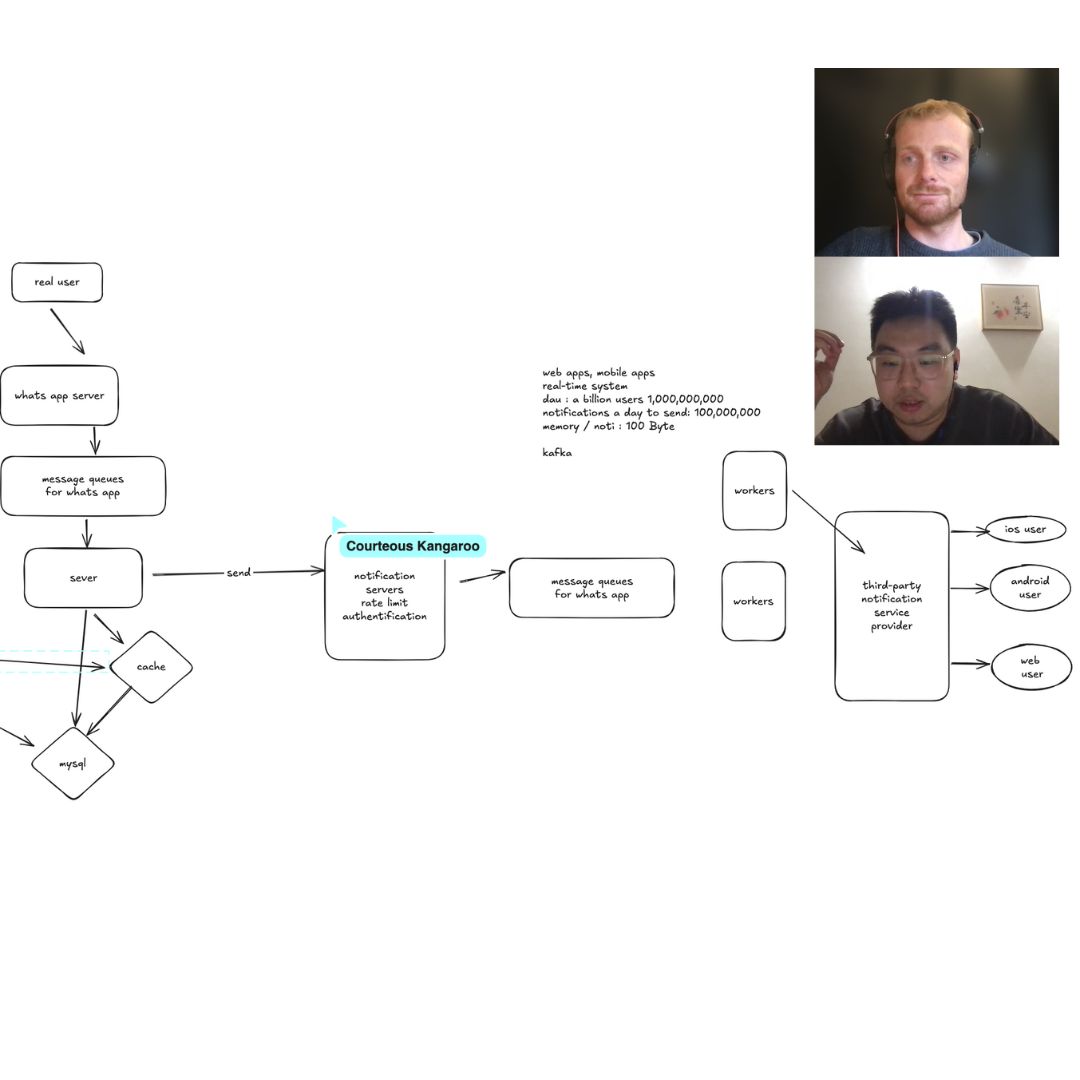
These are the classes we actually ran, not a generic curriculum. Each one started from a real interview question.
Class 1
System design
Design YouTube
- Clarification: boil [something] down; bare bones; in-scope / out-of-scope
- Propose then clarify (especially video safety); malicious / harmful content
- Upload vs download flows; pay-per-use; % of users who upload
- Restate requirements to stay on the same page
- Idempotency pronunciation; 1080p / 4K; geographically; associated with
Class 2
System design
Notifications + web crawler
- Roughly / approximately / ballpark; SLA; 99.999 spoken clearly
- Graceful toward third parties; production vs consumption rate
- Based on my experience at X…; anything I’m missing?; aligned / on the same page
- Traffic spike; scale in/out, up/down; max capacity; guarantees uniqueness
Class 3
Trie deep-dive
Search autocomplete
- Instant messaging app; policy; browser; localised; debounce
- Aim for latency / give an SLA; availability as uptime
- Trie pronunciation; core concept / in a nutshell; deep-dive the trie
- Traverse (not tranverse); out-of-the-box; rank / calculate weights
- Record vs record noun/verb stress
Class 4
Vocabulary
Business dialogues warm-up
- Beta users, unique selling point (USP), end user, leadership (not “the boss”)
- Resistant to change; conversion rate; nurture; flywheel; from scratch
- Pain points; in-house; early stages; word of mouth
Feedback
Coach notes from those sessions, kept as they were given in class.
Restate requirements
A one-sentence recap prevents building the wrong YouTube.
Aim for an SLA
“We hope latency is low” is weak. Aim for a number and name availability.
Propose safety scope
For upload products, propose what is in/out of scope for malicious content, then clarify.
Trie deep-dive needs signposts
In a nutshell → deep-dive → small optimisation. Keep the interviewer oriented.
Common Mistakes
Corrections from live answers, the same patterns that showed up in class.
| Heard in class | Use instead |
|---|---|
| “Boils down to (no object)” | “Boils down to [X]” Needs a noun phrase. |
| “We hope that latency…” | “We aim for latency of…” SLA language. |
| “Tranverse” | “Traverse” TRUH-verse. |
| “This is not scaling” | “This is not scalable” Adjective form. |
| “The boss” | “Leadership / management” More professional. |
Before and After
Before coaching
- Soft latency language (“we hope”)
- Content-safety scope left unclear
- Pronunciation blockers on key terms
- Deep dives without signposts for the interviewer
After coaching
- Requirements restated aloud
- Concrete latency and uptime targets
- Idempotency and traverse usable live
- Trie deep-dive with a clear structure
The Result
Clearer English for YouTube- and autocomplete-style system design interviews. Clarification, SLAs, and deep-dive signposting improved. Readiness - not a promised offer - was the goal.
What to practise for design interviews in English
- Restate requirements before you draw.
- Replace hope with aim-for latency and uptime targets.
- Drill idempotency, traverse, and geographically aloud.
- Signpost deep dives: in a nutshell → detail → optimisation.
- Propose safety and policy scope, then clarify.
Why System Design Interviews Stress English
You are graded on how you think out loud. Mispronounced core terms and soft SLAs make a strong design hard to trust. A fixed spoken order plus practised deep-dive phrases keeps the round coherent in a second language.
Preparing for a similar path? Read How a Singaporean Software Engineer Built Interview-Ready English.
Learning paths
Practise in the course
Start with your introPractise explaining system design in English
No card required. Start with a 7-day free trial - a lesson, a mock interview, or both.
Join 500+ preparing for global roles
Other engineers practising interview English

Mockly knows what it takes to get hired. The preparation covers behavioral, algorithm, and system design interviews thoroughly - with real expertise in the STAR method, LeetCode, and Alex Xu’s system design frameworks. And when it comes to English and communication skills, the native-speaking mentors make all the difference.

I’ve had the pleasure of practicing English with Mockly and I truly appreciate the progress I’ve made. I highly recommend their services to professionals in tech and beyond. I particularly enjoy the teaching style and the philosophy behind it: “If you enjoy the process, you’ll get it.” The personalized learning plans make every session practical and useful. Their hands-on knowledge and genuine interest in the world of technology will genuinely boost your English skills.
FAQ
Questions
More questions? Email us at contact@mocklyenglish.com.
Similar case studies
How a Singaporean Software Engineer Built Interview-Ready English
Written English was fine. Spoken answers stalled. See how one Software Engineer from Singapore practised system-design answers out loud.
Preparing for a Chat System Design Interview in English
System-design classes covered TLS handshakes and a full chat system in English: clarification questions, SLAs, queues, and scalability discussion - no offer claimed.
More case studies
Related resources
Case studies are illustrative, based on patterns from real coaching sessions.